Chapter-10
Personnel management & Administration.
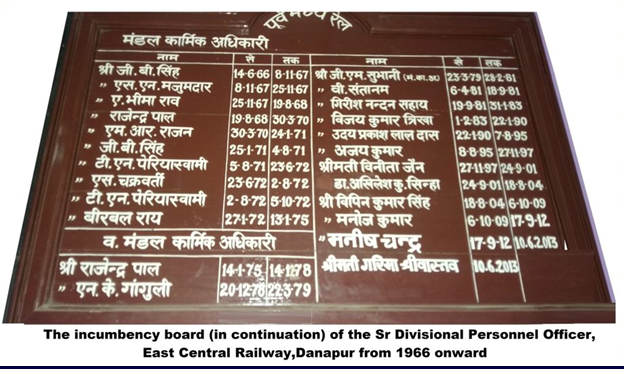
From the post of Sr Divisional Engineer/Mughalsarai I was transferred and posted as Sr Divisional Personnel Officer/Danapur. (Sr DPO/DNR) in 1981.The old incumbency board displayed in the chamber showed that it all started with the designation of ‘Superintendent Staff’ when the division came into being on the 1st January 1925. Subsequently the post was designated as ‘Divisional Personnel Officer’ and upgraded as ‘Sr DPO’ in 1975.
Personnel Management, also known as Human Resource Management, is the effective process of managing the workforce of the organization, including recruitment, training, evaluation of employees’ performance, remuneration & benefit administration, industrial relations, and compliance with labour laws & regulations.
I was excited at this posting. My batchmate who had worked as Sr DPO/Jabalpur when contacted was happy at this news and cautioned me that the post called for better skill and sensibility than corresponding post in our own department. Expenditure on staff accounts for 40 percent of the total operating expenses. The Executives are accordingly expected to devote 40 percent of their time on staff matters. I had taken over charge of the post from Sri V. Santhanam, IRSEE. A few days before his transfer he had issued orders for reshuffling of the staff from one table to another. This ruffled those who had stayed at their tables for years and had invited complaints about harassment to the staff on establishment matters. Not happy with the transfer order they put pressure on me from different sources. However the DRM advised me to be firm on implementation of the transfer orders in totality. A confidential cell and a secret cell were attached to my chamber. Senior Labour Welfare Inspectors managed the PNM cell and visited outstations to collect staff grievances and redress them. Sadhu was the table peon who wielded large beard like a hermit and thereby commanded respect from the staff. In fact, instead of Sadhu referred to as Sr DPO’s peon it was the Sr DPO who was mentioned as Sadhu’s Saheb.
Industrial Relation - Permanent Negotiating Machinery (PNM) was set up at Railway Board level, Zonal level and Divisional level in 50s to enable the administration to sustain genial relations with the labour and to resolve disputes and differences between the two cordially. However, disciplinary matters and individual cases of transfer and promotion were not discussed in the PNM meetings. Only the subjects which were within the powers of the officers, were discussed. The matters on which the unions are not satisfied at a particular level, are raised at the higher level. At Danapur, I had to arrange PNM meetings with the two recognized unions viz Eastern Railway Men’s Congress (ERMC affiliated to NFIR) and Eastern Railway Men’s Union (ERMU affiliated to AIRF) in alternate months. The Branch officers used to turn up one by one to discuss the issues relating to his department. Finally, I visited DRM’s chamber to apprise him of the matters on which his decisions are solicited by the Union. After his address the meeting was over. The matters on which the Union was not satisfied with the DRM’s response were raised in the headquarters PNM meeting. The Union representatives were all railway employees but during the meeting they behaved like real leaders-thumping & shouting.
Participation of Railway Employees in Management (PREM) - Set up in 70s, it also works at Railway board level, Zonal level and Divisional level with a view to obtaining better and systematic participation of the labour unions in the management. Members of the officers Association also join. The underlying objective is to provide a forum for the exchange of ideas for improving railway efficiency and enhancing the image of Railways as a service provider.
CPO during inspection of DNR advised me, ‘There is no hurry in decision making. But once you take a decision stick to it.’ When my welfare inspector was promoted as Assistant Personnel Officer and posted at the headquarters at Kolkata, he requested me to prevail upon CPO to retain him at DNR itself while implementing the promotion order. I was not very enthusiastic about it but when CPO arrived at DNR in the coming days I reluctantly conveyed to him the submission of my Inspector. CPO asked me if I was convinced about it or simply clearing my conscience. He had read my mind. I admitted the latter. The CPO sent for him in his saloon and explained to him in my presence that if he remained at the same station even on promotion the staff would continue to view him in the capacity of his earlier post. As a result, he would not be in a position to exercise his authority in the manner expected of him. The Inspector was persuaded to carry out the transfer order with an assurance that his request would be given due consideration after some time.
Nalanda & Rajgir- Danapur division has an Officers rest house at Rajgir . Since its booking is controlled by the engineering department of Danapur I made use of this opportunity to visit Nalanda and Rajgir
Nalanda-It was an acclaimed Budhist monastic university and included, Chaityas (temple like structures), Vihars (residential-cum-scholastic structures), Stupa (a hemispherical structure symbolizing the burial mound of Buddha) and shrines which fascinated intellectuals from Asian countries including the Chinese scholar Xuan Zang. Established during the 5th century C.E it was engaged in organized dissemination of knowledge over an uninterrupted period of 700 years , until it was destroyed by the Islamic invader in 1200 C.E. and eventually abandoned & forgotten. There is nothing left for restoration. However the remains amply bear out Mahavihara’s planning, layout, stucco & engraved artwork and ornamental embellishments . It is now a UNESCO world heritage site.
Rajgir -It was the former capital of Magadh kingdom. Surrounded by 5 hills it is famed for its 7 hot springs which mingle together into a big pool of warm water. It is a spiritual place with natural serenity. Both Gautam Budha and Swami Mahavir are believed to have spent time here during 6th & 5th century B.C. teaching their religious beliefs. To protect the city from invaders and enemies the city was protected by a 45 kms Cyclopean wall encircling Rajgir ,during the reign of king Jarasandh. It is a stonework masonry built of undressed and semi-dressed stones without any mortar. Constructed around 2600 years ago the Cyclopean wall is considered among the world’s oldest protective masonry and predates the Great wall of China. Only some portions of it remain. Most of the original structure has disappeared with time. The wall is currently designated as a national monument. Though the oldest example of defense architecture, it hardly holds attraction for the visitors.
Ruling--While we were probationers at the then Railway Staff college, Baroda during 1963 Sri B.B.Dutta, then Director (B&F) had come to address us. 17 years hence I was destined to meet him in a different capacity. One day I found one elderly gentleman walking into my chamber escorted by my staff. He was introduced to me as Sri B.B.Dutta ex Divisional Personnel Officer, Danapur and ex DS/ Danapur. I remember to have noticed his names in the old incumbency board in my chamber and that of the DRM. I extended to him due courtesy and asked him the purpose of his coming to me. He told that he had taken a pass ex Guwahati to Lucknow with break journey at Muzaffarpur where his son was DM. There he fell sick. By the time he recovered the validity of the pass had expired. So, he wanted an 'in lieu' pass for uncovered portion of his journey (MFP to LKO). I felt uneasy as to me it was against the rules. Unsatisfied he went to the Divisional Railway Manager (Sri R.N.Tewary). After hearing both the sides the DRM was in a fix. He was convinced of my stand but at the same time as he did not want to embarrass Sri Dutta. A via media was found that the matter would be referred to the CPO and his decision conveyed to Sri Dutta. A staff was booked. CPO was apprised of the situation. On the second day the staff returned with CPO's decision ruling inadmissibility of such a pass. The same was conveyed to Sri Dutta who acknowledged it in the following words: "I abide by the decision of the Administration".
During my two years tenure in this ex cadre post I learnt valuable lessons in industrial relation and staff welfare. It was also an opportunity to appreciate things like ‘selection & non-selection posts’, ’40 point roster’, ‘proforma fixation’, ‘fortuitous’ ‘dies non’, ‘commuted leave’, ’quarantine leave’ ’next below rule’, ’Ruling’ ‘year ending pass’ etc. There were instances where a staff died while in service and a case arose for appointment of his ward on compassionate ground but could not be effected because the aspirant happened to be underage. Under such a situation rules provided for the waiting period till attainment of the eligibility. On a number of occasions my acquaintances approached me for a choice transfer/posting and I had difficult time in convincing them that it was within the powers of the Branch officers and not me. I had control only with regard to change of table for my staff in the divisional office at Danapur . Correct accountal of leave (LAP & LHAP) of the outstation staff, requisite recovery of house rent and safeguarding unauthorized retention of the quarters from the staff undergoing transfer was a difficult task for indifference from the outstation bill preparing units. This accounted for a good number of items in the PNM meetings.
Additional Divisional Railway Manager (ADRM)-- While I was functioning as Sr Divisional Personnel Officer orders were received for my promotion as ADRM with posting at Mughalsarai. But it so happened that before it could be implemented some differences arose between the ADRM and the DRM/Danapur on an issue. The DRM, not happy with this development, prevailed upon the GM to post the incumbent of the post of ADRM elsewhere. So, the transfer order was swapped, and I joined as ADRM(General)/Danapur in 1983. Sri T.C.Subarno IRTS was ADRM (Operations).
The post of ADRM was created by the Railway Board with a view to offloading the duty list of the DRM by authorizing him to delegate some of his powers to the ADRM with Finance concurrence. But the functioning of this tier of administration had not crystallized by that time. The DRM (Sri Kranti Kumar) asked me to continue to look after the personnel matters. This was welcome as in this post I was able to find time to visit stations and take notes of leave availed by staff and recovery of house rent from the staff retaining quarters at the old station even after transfer to a new station with a different pay bill unit. This put pressure on the personnel officers & the dealing clerks to update the leave account and recover house rent from the staff wherever due. Nevertheless the idea of exercising DRM’s power in respect of Discipline & Appeal matters made me uneasy because of their quasi judicial nature. The DRM also entrusted me with the task of budgeting and safety which I liked. On a couple of occasions I had to conduct night inspection with the Divisional Safety officers to check the alertness of the staff on duty. The enquiry report for yard derailments ,not involving a train, were required to be settled at the divisional level and responsibility fixed. In some cases this task devolved on me. This was an unsettling job specially when integrity of the track was in question.
The duty assigned to me to conduct ticket checking with the officers of the commercial department excited me . But I was intrigued to find that the TTEs ,although authorized to charge anybody without a valid railway ticket ,sometimes evaded the situation when confronted with a police official in uniform or someone claiming to be a high placed government official & passed on such cases to the officers. While conducting ticket checking at PNBE, I was careful to inform the GRP to be in readiness to deal with any untoward happening. In bus raids we had the backing of lathi-wielding police force, a police officer and an Executive magistrate from Patna Jn, Ara or Kiul. The trains were stopped in the mid-section by placing detonators. However, we avoided check on peak hour locals. During one such check at Khusrupur the crowd went rowdy and gheraoed the DCS at the station. The Railway magistrate accompanying us was waiting outside in the bus. On being informed he ordered lathi charge. It was for the first time in my life that I saw such an operation from a close range. On hearing about this incidence, the nearest GRP also arrived. The police officer told us to keep him informed about such bus raids. Patna-Gaya trains are notorious for without ticket travellers. A train starting from Patna Jn for Gaya is stopped near the Mithapur level crossing. Hundreds of passengers afraid of being caught without ticket at the station wait there to entrain. In reverse movement a train from Gaya to Patna is stopped at the same place for the benefit of without ticket travellers. Once we conducted bus raid on 2 PG train (coming from Gaya) by stopping it on approach of PNBE near the bypass ROB. Since the train was ambushed ahead of the familiar level crossing it surprised the without ticket travellers. A number of them were apprehended. The railway magistrate was fond of standing near the 1st class coach to see that the unauthorized travellers therein did not escape with impunity. In this raid said a genuine first-class passenger “Sir, I wish you could have conducted this check earlier so that I could travel in comfort which I deserved.” But it was an anxious moment while conducting bus-raid near Sheikhpura in the Kiul-Gaya section, by stopping a train in the mid-section. It so happened that amongst the without ticket travellers rounded up were also a few students of the local college. While returning to Kiul we had to pass by the same college on the way. There the students lay in ambush and attacked our bus hurling stones. We took shelter under the seats. The infuriated magistrate ordered lathi charge. The strong contingent of policemen accompanying us did a thorough job. However, a few railway staff had sustained minor injuries due to stone pelting. One day the Sr DCS complained to the DRM that the news of bus raids were leaked by the control and the people escaped detection and penalty by purchasing tickets. The DRM smiled and said that one of the purposes of the bus raid is to increase the window sale which is well served in this process.
To arouse curiosity and create awareness amongst railwaymen’s children, in one railway week a steam engine was placed in a siding at Danapur next to a road. The excited children after promising sensibility for Rly assets were allowed to board it and blow a whistle. A certificate signed by the DRM was then granted to them. A length of track was laid in the premises of the Club on which a motor trolley ran to and fro, delighting the children.
DNR branch of the Eastern Railway women’s organization had organized a Fete in the club’s premises to raise funds for charitable purpose through cultural show and sale of goods & snacks. A souvenir was brought out at in which many agencies advertised their goods & services. The local police was kept informed of the event to ward off any untoward happening. RPF personnel were also on guard. Earlier the DRM had served in N.E.Rly where he had witnessed functioning of solar cooker. Impressed by its performance he asked me to visit GKP to see its construction & working. The appliance was available with the Sr DGM who took pains to explain the details to me. I made some sketches after taking its measurements and returned. Back at DNR an engg drawing was prepared and assigned a number. Even a prototype was made in the Engg workshop which came as per expectation.
While as Sr DPO/DNR, I was allotted bungalow no 44 DEF near the Rly hospital. Apart from a couple of guava trees, there was a large canopied mango tree in the compound. Its blossoms were fragrant, and their sweet scent pervaded the air during the months of February-March .There used to be luxuriant growth of king-size fruits in it for which it was well nursed. The surrounding of the bungalow bustled with life during festivals. It was fascinating and even after promotion as ADRM Danapur I continued in it.
